The Pottery Barn Rule Comes to Caracas — Washington's Venezuela Order Serves the Oil, Not the Venezuelans
By Dorian Kantor and Elisabeth Weber
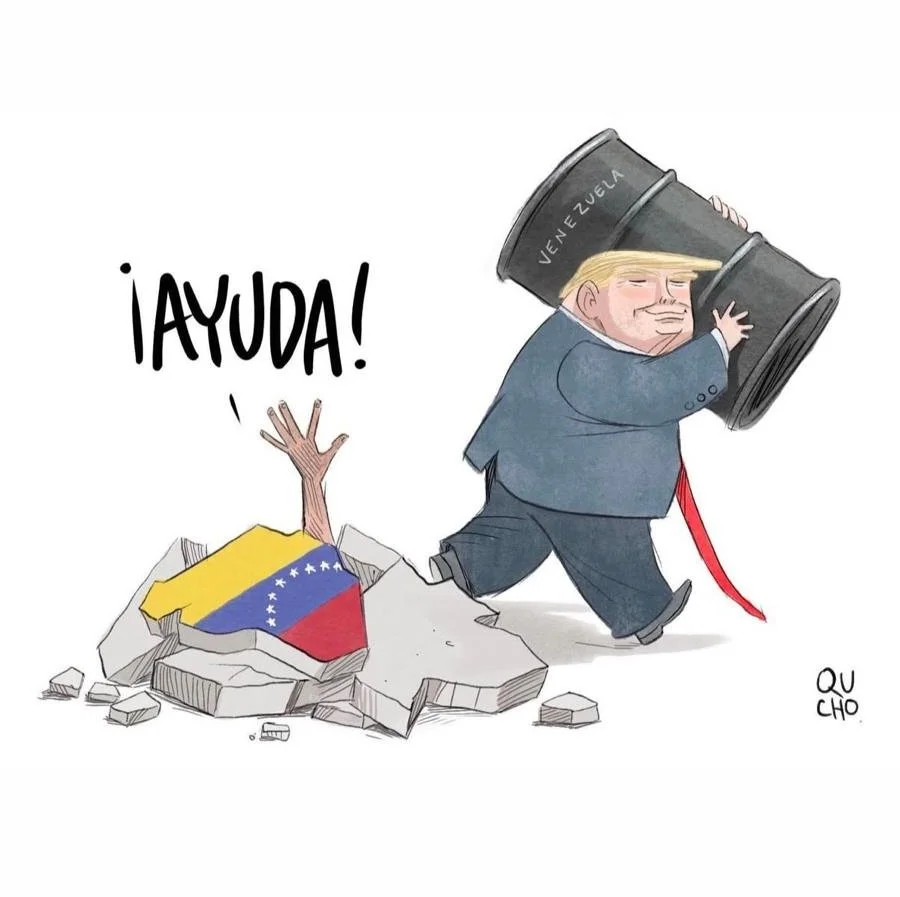
Illustration: Qucho Moreno
Read the full analysis: PDF (English) or in Spanish on El Espectador’s website.
Bottom line. Washington kept the credit and the oil for reordering post-Maduro Venezuela while refusing the responsibilities of governing it — and the June earthquakes turned that control-without-accountability into a mass-casualty crisis.
Asked about the U.S. response two days after twin earthquakes devastated Caracas, President Trump said: "the oil is flowing… we're going to help them out, but we did that." The line holds the post-Maduro order in miniature — authorship of the reordering claimed without qualification, help offered as optional charity rather than obligation. By seizing Venezuela's oil wealth and decisive influence over its transition while declining formal responsibility for governing, Washington built a structure of control without accountability. The disaster forced the question the arrangement was designed to avoid: if the United States takes credit for Venezuela's new order, who answers when Venezuelans die in collapsed buildings and failed hospitals?
What's happening
The order that followed Maduro's capture in Operation Absolute Resolve rests on strategic ambiguity. Trump said the U.S. would "run the country"; in practice that meant lifting sanctions, centering oil licensing, and leaving a reshuffled chavista administration as the local interface. María Corina Machado, useful while the transition needed a democratic façade, was quickly sidelined. The result sits between occupation and alliance: Washington shapes the macro-order — recognition, sanctions mechanics, oil stabilization — while a caretaker without democratic legitimacy carries the formal duties of a state. Supervision without sovereignty.
Why it matters
The earthquakes are an audit of that order. Two quakes (magnitude 7.2 and 7.5) struck on June 24; by July 6 the confirmed toll had reached 3,342, with the USGS warning it could exceed 10,000. Earthquakes kill through institutions as much as tectonics — and for six months the transition's bandwidth went to recognition, oil stabilization, and sanctions, not the state functions that decide who survives. Washington's response — roughly $150 million routed through NGOs and faith-based groups, rescue teams, Secretary Rubio's condolences — is donor behavior, not sovereign responsibility. Aid is not accountability. Colin Powell's Iraq-era rule warned that a power that breaks a political order owns the consequences; Venezuela inverts it — Washington kept the material benefits and shed the liabilities. Outside the JW Marriott, now thick with dealmakers as a new hydrocarbon law draws investment and output climbs back above a million barrels a day, inflation runs in triple digits.
What to watch
Whether the accountability vacuum holds as the toll climbs; whether any political opening materializes beyond token prisoner releases; and whether the oil-first arrangement — recognition, licensing, investment — survives contact with a population it does not serve. The structure recalls the Gómez-era oil kleptocracy and confirms the Monroe Doctrine is alive and well.
Related Kantor Consutling analyses:
Reorganized, Not Dismantled: Post-Maduro Venezuela