Three Candidates, Three Models: Colombian Foreign Policy in Dispute
by María José Báez, María Paula Martínez, Dorian Kantor
Context
Colombia's 2026 presidential elections are unfolding in a context of profound transformation, both domestically and internationally. On the internal front, the country enters this electoral cycle after a period marked by intense political polarization, a reconfiguration of the party system, and sustained debates over the development model, security, and governance. Externally, Colombia faces an environment shaped by intensifying great power competition, fragmentation of the Latin American regional order, and the reconfiguration of strategic alliances. In both dimensions, the government of Gustavo Petro presented itself as a break with tradition — a claim that has sparked debate over whether the change was substantive and whether it ultimately benefited the country.
Against this backdrop, it is necessary to examine the historical precedents that have shaped Colombian foreign policy. Far from being a secondary domain, decisions in international relations directly affect critical areas such as security, trade, migration, and institutional stability. The 2026 elections are not merely about leadership turnover but rather pose a structural dilemma regarding Colombia's model of global engagement. The leading candidates represent divergent visions, ranging from the pursuit of greater strategic autonomy, to reaffirming traditional alignment with the United States, to adopting more disruptive stances toward the existing international order.
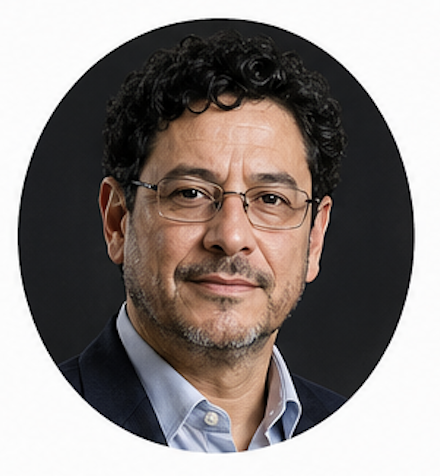
Iván Cepeda
Autonomy and regional integration
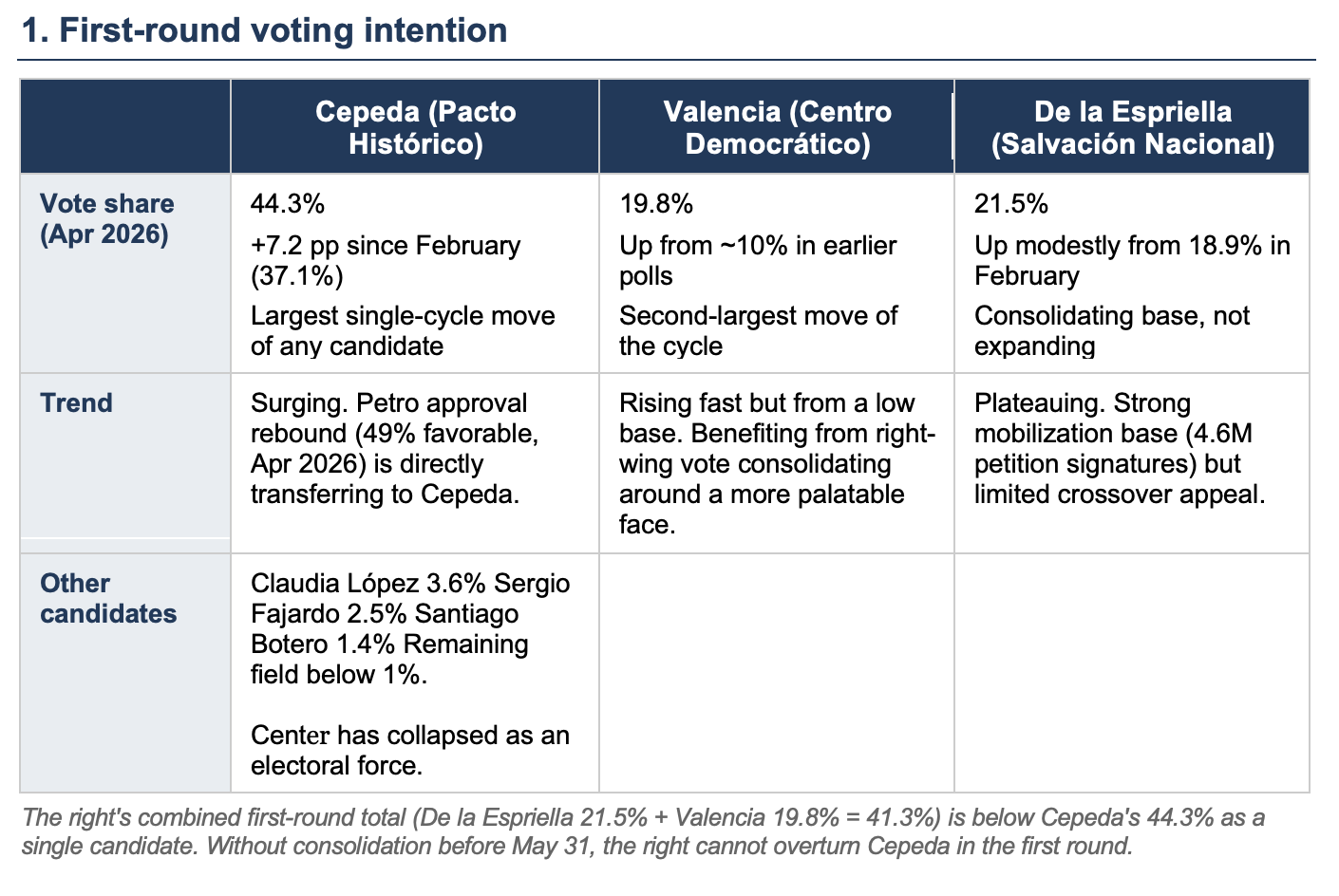
Iván Cepeda Castro, the left-wing candidate of the Pacto Histórico, is the contender with the most developed and consistent foreign policy positions over the course of his career. Since 2020 — when, as a senator, he criticized the government of Iván Duque for leading the Lima Group without tangible results, arguing that the strategy ultimately strengthened Nicolás Maduro — to his recent statement from the UGT headquarters in Madrid that "Colombia is neither a colony nor a protectorate of any power," Cepeda has maintained a coherent line rejecting unconditional alignment with Washington.
His government program includes explicit sections on foreign policy, stating that it "must be oriented toward peace, the defense of human rights, autonomy, and regional integration, and, by nature, the protection of migrants." Among his priorities are the restoration of relations with Venezuela, the opening of a commercial zone along the 2,200 km shared border, and the consolidation of Latin America as a zone of peace through cooperation among countries with shared characteristics. He has also expressed opposition to extraditions — a stance that would mark a rupture in security cooperation with the United States — and has rejected the presence of U.S. troops on Colombian soil.
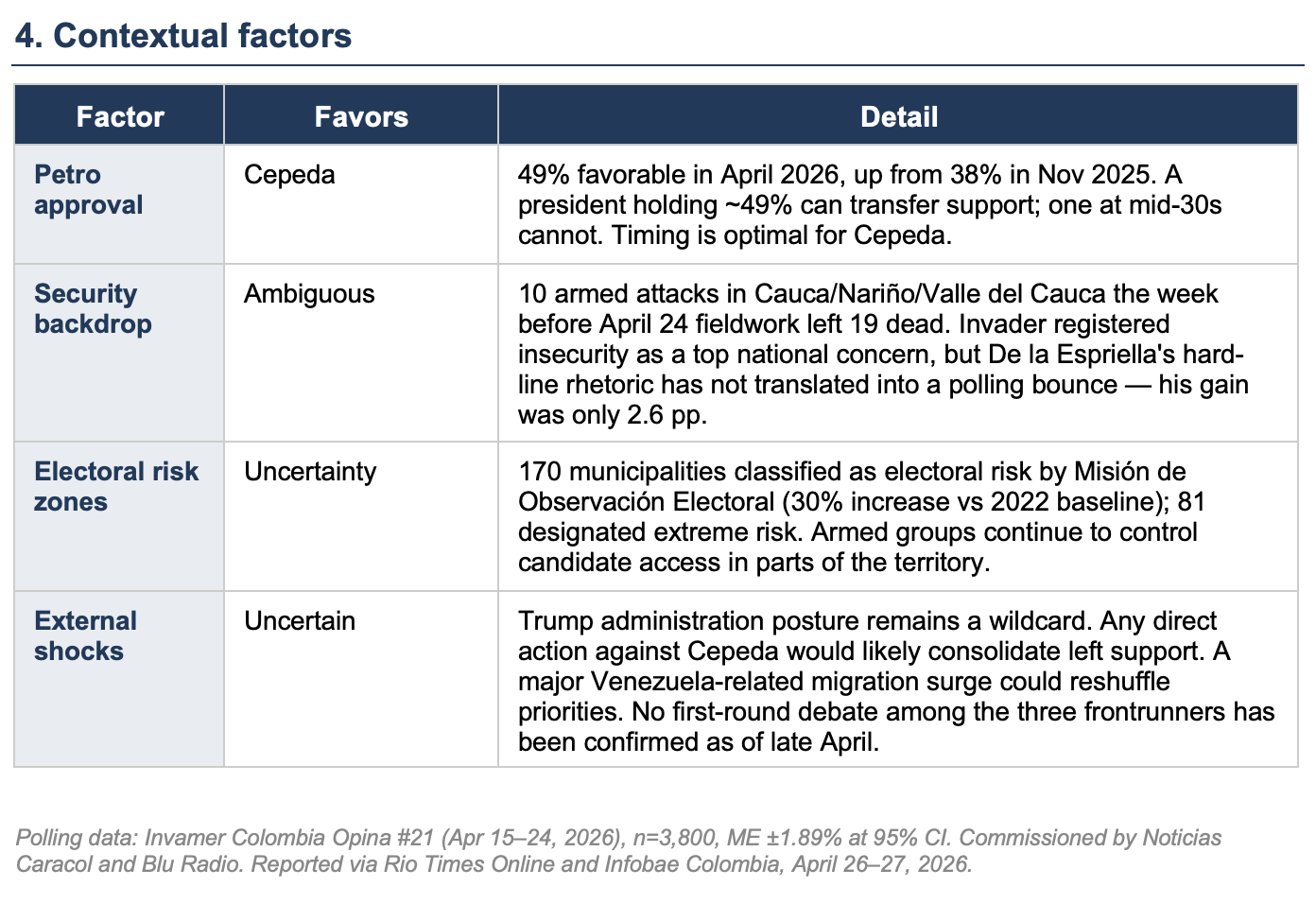
The most immediate reference point for his proposal is the Petro administration, whose foreign policy was characterized by a relative distancing from Washington and a diversification of partnerships toward actors such as China and Venezuela. That period demonstrated both the opportunities and the constraints of a strategy of autonomy within a context of structural dependence. Tensions with the United States culminated in trade sanctions in 2025, when Colombia was designated a country "failing demonstrably" in counternarcotics cooperation and faced tariffs ranging from 25% to 50% on products such as coffee, flowers, and hydrocarbons — a clear signal of the costs associated with operating outside Washington's orbit.
Cepeda has already met twice with Mexico's president and once with the presidents of Brazil and Spain, seeking to articulate a bloc of ideologically aligned governments. He supports regional integration mechanisms, although he has acknowledged that organizations such as CELAC have lost momentum. In this regard, his position is not entirely novel: the second administration of Juan Manuel Santos, despite its ideological distance from Petro, also pursued strategic roles within the Association of Caribbean States and the Andean Community. What Cepeda frames as rupture in fact has deeper roots of continuity than his discourse suggests.

Paloma Valencia
Respice Polum revisited
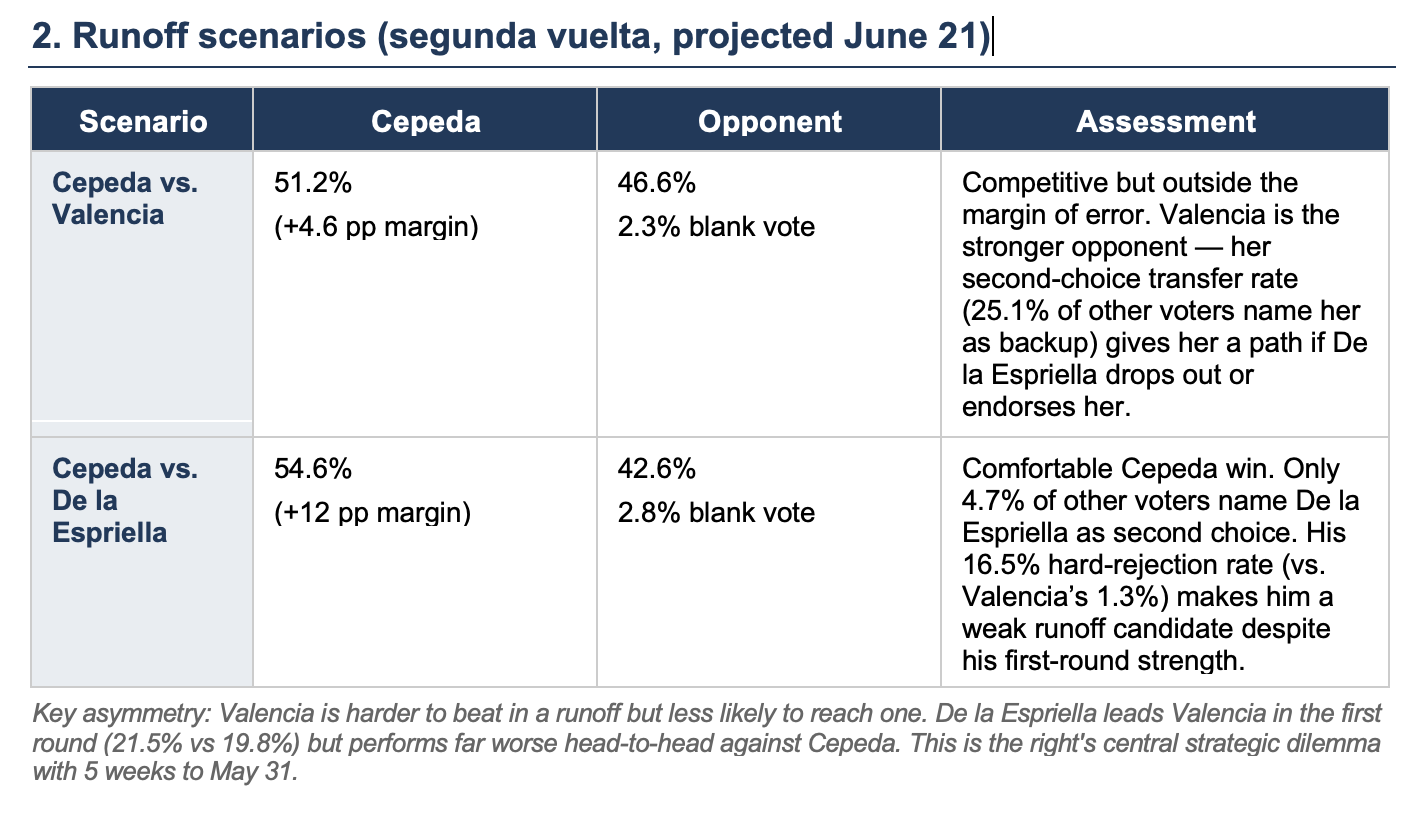
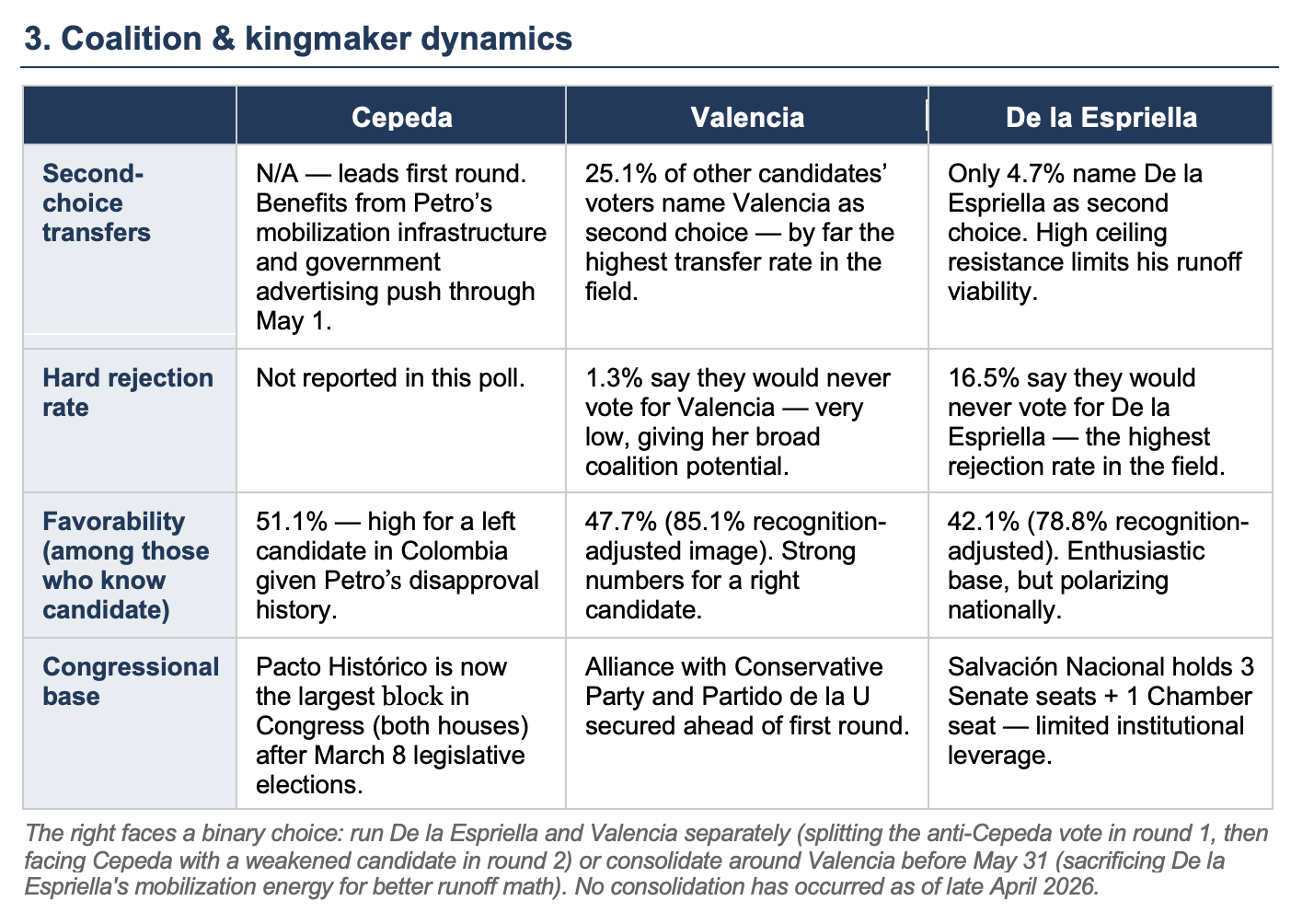
Paloma Valencia’s proposal represents a reactivation of the strategic alignment model with the United States that characterized the Uribe and Duque governments — known historically as Respice Polum, “looking north.” Her approach prioritizes cooperation with Washington, including what she herself has described as the need for a “Plan Colombia 2.0” to restore security. In her own words, “the United States has been our ally in the defense of liberty, democracy, and sovereignty” — a formulation that places her security agenda in direct continuity with the Pastrana and Uribe administrations, centered on combating drug trafficking through penalization and criminalization. Her government proposals include a 20-trillion-peso increase in the security budget.
Valencia has expressed her intention to convert the Foreign Ministry into a de facto Ministry of Foreign Trade, with ambassadors functioning as export promoters. While strengthening the Free Trade Agreement and attracting foreign direct investment are legitimate objectives, reducing diplomacy to its commercial dimension implies a narrow vision of foreign policy that could limit Colombia’s capacity to navigate an increasingly complex international environment. Her posture toward China suggests a strategy of economic continuity without political alignment — consistent with recent tradition — though her government plan lacks precise textual development on this matter.
Valencia defines herself as a “pure-blooded Uribista” and her political lineage condenses much of Colombian history. She is the granddaughter of former president Guillermo León Valencia (1962–1966) and of Mario Laserna, founder of the Universidad de los Andes, placing her squarely within the elites that have governed the country in near-unbroken succession. Her push for harsher sentencing, reform of social protest norms, and judicial strengthening aligns with the iron-fist tradition of her party. In foreign policy, her refusal to recognize the situation in Gaza as genocide and her position of not blocking relations with Israel reflect alignment with the regional right and Washington.
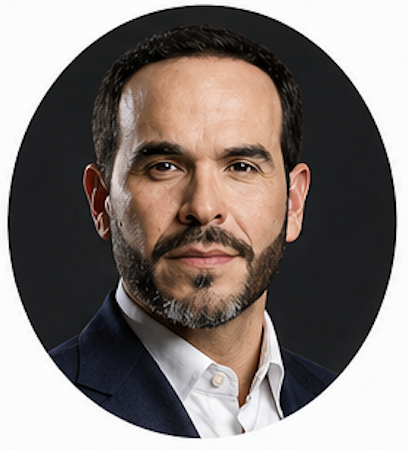
Abelardo de la Espriella
The conservative outsider
Abelardo de la Espriella shares with Valencia the idea of converting embassies and the Foreign Ministry into instruments of commercial promotion — going as far as claiming he will hand diplomats a list of products to sell, and that those who fail to sell will be expelled from the diplomatic corps. Economically, he identifies as a “libertarian” and advocates intensive exploitation of resources such as oil, gold, silver, and rare earths as an export engine — a model that does not break with Colombia’s tradition of commodity dependence, despite the rupturist rhetoric. He has claimed that the fall of the Venezuelan regime would benefit Colombia by turning it into Venezuela’s main supplier of goods and services, though this projection lacks support in his formal proposals. His programmatic archive contains no structured foreign policy plan.
The most relevant parallels for his candidacy are not historical but contemporary: Jair Bolsonaro in Brazil, Javier Milei in Argentina, and Nayib Bukele in El Salvador. De la Espriella consciously emulates these models — from the language (“apply the chainsaw to the State,” a direct reference to Milei) to the aesthetic (the military pose, the totemic animal — a tiger where Milei chose a lion — and the family presented as an aspirational standard). He presents himself as a political outsider, yet faithfully embodies the conservative values the traditional right seeks to preserve, with a more theatrical and youth-friendly packaging. The international experiences he emulates show that this approach can generate tactical benefits in the short term, but also tends to produce greater volatility, relative isolation, and dependence on personalist alliances.
Conclusion
The three candidates represent not entirely new proposals but rather variations of established trajectories in Colombian foreign policy: relative autonomy with a Latin Americanist orientation, strategic alignment with Washington, and right-wing populism combining disruptive rhetoric with a conservative core. What is at stake in 2026 is not merely a change of government, but a decision about the role Colombia seeks to play in a reconfiguring international order — and about the types of dependencies it is willing to assume in order to sustain that role.